.png)
Creating a Memorable Brand in 2025
- Rande Vick

- Oct 15, 2025
- 4 min read
Updated: Nov 25, 2025
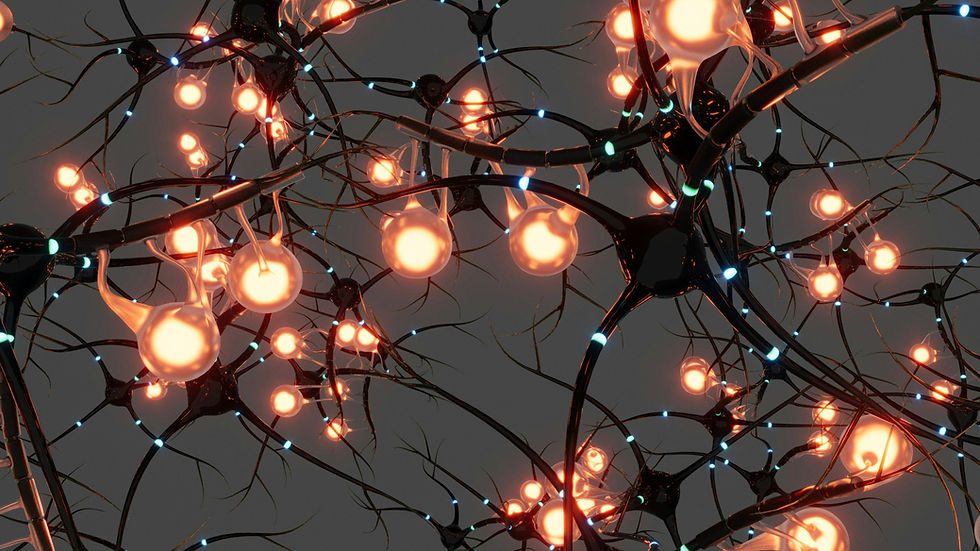
How does one Create a Memorable Brand in 2025? Easy: Neurobrand Strategy.
I took a meeting with a potential client last year, after he had spent $200K on a brand refresh. New logo, new website, award-winning design work. Six months later, their brand awareness study showed promising recognition numbers – people could identify the logo when they saw it.
But when asked to name companies in the category unprompted, the client didn't make the list.
They had visibility without memory. And in branding, that's the difference between being seen and being chosen.
Here's the problem most brands don't see coming: recognition and recall are not the same thing.
Your brain processes them through entirely different neural pathways.
↳Recognition is passive – "I've seen this before."
↳Recall is active – "When I need this, I think of them first."
One keeps you in the game. The other wins it.
This distinction matters because of what the Ehrenberg-Bass Institute calls the 95:5 Rule. At any given moment, only 5% of your market is actively ready to buy. The other 95% isn't ignoring you out of malice – they're just not there yet.
They're researching, budgeting, waiting for approval, dealing with other priorities. Your brand's job isn't to convert them today. It's to be the first name that surfaces when they finally are ready.
And that doesn't happen through awareness. It happens through memory formation.
Read "NeuroBrand Strategy: The future of branding" here!
Most brands are investing millions in awareness campaigns that create recognition without recall – which means they're essentially funding their own invisibility. They're training the market to recognize them in the moment while remaining forgettable the second the interaction ends. It's the brand equivalent of studying for a test by reading the same paragraph over and over without ever closing the book.
The neuroscience of brand memory operates on different principles entirely.
Take immersion. Not "engagement" or "interaction" – actual cognitive immersion, the state where your prefrontal cortex quiets and your brain shifts into absorption mode.
This is measurable. Dr. Uri Hasson's research at Princeton showed that when people are deeply immersed in a narrative, their brain activity literally synchronizes with the storyteller's intended meaning. That synchronization – what we call neural coupling – is what transforms information into memory.
But here's where most brands miss it: immersion isn't about volume or frequency. It's about depth of processing. A single moment of genuine emotional resonance will encode more strongly than a hundred exposures that barely register.
Your brain tags emotional experiences with a neurochemical marker that essentially tells your hippocampus, "Keep this one." No emotion, no marker. No marker, no long-term memory.
Everybody wants to Create a Memorable Brand, but nobody understands how memory works
This is why brand experiences that feel performative or manufactured fail at the neurological level. Your amygdala is a sensitive instrument. It can detect inauthenticity in milliseconds. When a brand's emotional cues don't align with its actual behavior – when the story doesn't match the experience – the brain doesn't encode it as trustworthy. It encodes it as noise.
Subconscious priming works on the opposite principle: not depth, but consistency.
The brain builds memory through pattern recognition. When you encounter the same sensory combination repeatedly – a particular shade of red, a four-note audio signature, a specific turn of phrase – your brain begins building an associative pathway. These pathways operate below conscious awareness.
You don't decide to remember them. You just do.
This is why sonic branding works when done correctly, and why visual identity systems that constantly reinvent themselves undermine their own memorability. The brain needs repetition to build the neural shortcuts that enable instant recall. But that repetition has to be consistent enough to register as a pattern, distinctive enough to separate from category noise, and embedded in moments that matter enough that the pattern gets encoded in the first place.
The uncomfortable truth: Most brand strategy is optimized for the wrong outcome.
We've built an entire industry around capturing attention – impressions, reach, engagement rates, time on page. These metrics matter for visibility. But they tell you almost nothing about memory formation.
You can have massive reach and zero recall. You can dominate impressions and still be the brand people forget the moment they need what you sell.
Creating a memorable brand in today's economy means making memory the goal; not attention.
The brands that will matter in 2026 and beyond aren't the ones lighting up every algorithm. They're the ones building systematic memory advantages – designing every touchpoint not for momentary impact but for long-term encoding.
They understand that brand building is a neurological process, not just a creative one. And they're willing to measure success not by this quarter's awareness lift, but by whether they're the first name that comes to mind when the 95% finally become the 5%.
Because when your market forgets fast, being unforgettable isn't a positioning statement. It's a competitive requirement.
Learn how to make your brand unforgettable with The NeuroBrand Method™ Buy the book, Neurobranding; The Brain-Based Method to Make Your Brand Unforgettable
Need help applying this to your business? Schedule a consult with Rande Vick — creator of the NeuroBrand Method™ CLICK HERE, IT'S FREE!
For business leaders and brand strategists ready to move beyond trends, The NeuroBrand Method™ turns neuroscience into strategy that sells.


Comments