.png)
Essential Questions to Ask Before Hiring a NeuroBrand Agency
- Rande Vick

- Feb 23, 2023
- 4 min read
Updated: Jan 19

What to Know Before Working with a Neuroscience-Based Brand Strategist
Most firms hire brand consultants to solve the wrong problem.
They're experiencing revenue plateau, market indifference, or positioning confusion—and they assume the answer is better messaging, fresher visuals, or more aggressive marketing. So they hire an agency to execute tactics.
But if your brand challenge is actually an identity breakdown under complexity, tactical execution makes the problem worse. You're applying cosmetic solutions to ontological crises.
Before you invest in brand strategy work—especially neuroscience-based strategy—you need clarity on what you're actually solving for. The questions below will help you determine whether you need a traditional agency (to execute known tactics) or a strategic partner (to rebuild coherence from the foundation up).
Question 1: What's the Actual Problem?
Before "key results," get clear on the real issue:
Surface symptoms:
Inconsistent messaging across channels
Difficulty articulating what makes you different
Marketing that costs more but delivers less
Prospects who "need to think about it"
Team members who describe the brand differently
Root cause:
Ontological incoherence—your brand identity isn't grounded in a defensible truth about who you actually are
Neural dissonance—the gap between what you say and what clients' brains encode creates subconscious distrust
Identity breakdown—complexity has fragmented your brand into inconsistent expressions that fail to create lasting memory
If you're treating symptoms with tactics (new website, better SEO, social media content), you'll get temporary lifts followed by regression to the mean. If you're addressing root cause through ontological coherence, you're building permanent competitive advantage.
The right question isn't "What results do we want?"The right question is: "Do we have a tactics problem or an identity problem?"
Most firms have an identity problem. They just don't know it yet.
Question 2: How Will They Build Coherence, Not Just Messaging?
Traditional brand consultants ask: "What do you want to say to the market?"
Neuroscience-based strategists ask: "Who are you, actually—and does every touchpoint reflect that with biological precision?"
This distinction matters because your clients' brains make decisions about you subconsciously (95% of cognitive processing) before conscious evaluation ever begins. If your brand lacks internal coherence, their brains detect the dissonance—even if they can't articulate why they feel uncertain about you.
Before engaging a strategist, ask:
How do you establish ontological coherence before tactical expression?
What's your framework for ensuring neural coupling between our narrative and clients' existing mental models?
How do you measure whether our brand creates immersion (neurological synchrony) or just noise?
What processes do you use to identify where identity breaks down under complexity?
If they answer with "brand positioning workshops" and "messaging frameworks," you're hiring execution. If they answer with questions about your firm's deepest truths and how those truths translate into neurological realities, you're hiring transformation.
Question 3: Will This Build Memorability or Just Visibility?
Most brand work focuses on awareness—getting seen more often, by more people, through more channels.
But awareness without memorability is expensive noise.
Your brain is wired to forget most of what it encounters. Memory formation requires:
Emotional resonance (activating limbic structures)
Pattern recognition (coupling with existing neural architecture)
Coherent repetition (consistent encoding across exposures)
Traditional marketing increases visibility. Neuroscience-based strategy builds the conditions for lasting memory.
Before engaging a strategist, ask:
How does your approach account for the neuroscience of memory formation?
What creates neural coupling between our brand and our clients' decision-making processes?
How do you design for subconscious priming, not just conscious messaging?
What's the difference between brand awareness and brand encoding in long-term memory?
If they can't explain the biological mechanisms of memorability, they're guessing. And guessing is expensive.
Question 4: Do They Understand Your Market's Flattening?
Professional services markets are flattening—every firm sounds like every other firm, credentials blur together, and "thought leadership" has become indistinguishable noise.
This isn't a creativity problem. It's a coherence crisis.
When firms build brands reactively (responding to market trends, mimicking competitors, chasing differentiation), they create surface-level distinction without neurological depth. The result: forgettable brands that require constant reinforcement through expensive marketing.
Before engaging a strategist, ask:
How do you help firms build category authority rather than incremental differentiation?
What's your approach to ontological positioning vs. tactical positioning?
How do you create brand coherence that transcends market commoditization?
What does "unforgettable" actually mean at a neural level?
If they're selling "unique brand voice" and "compelling storytelling," they're offering the same flattened solutions everyone else provides. If they're talking about building brands from identity coherence outward, you're having a different conversation.
Question 5: What's Their Actual Methodology?
Branding is not a mystical creative process. It's applied neuroscience.
At Vick Agency, we use The NeuroBrand Method™—a framework grounded in peer-reviewed neuroscience research, built around three biological requirements for memorability:
1. ImmersionCreating neurological synchrony where your clients' brains align with your narrative (measurable through oxytocin response and cortisol reduction)
2. Neural CouplingEnsuring your brand activates existing neural patterns rather than requiring clients to build new cognitive frameworks
3. Subconscious PrimingDesigning touchpoints that shape perception before conscious evaluation—building trust at the biological level
This isn't brand theory. It's how memory, trust, and decision-making actually work.
Our process begins with ontological questions (Who are you, really?) before tactical execution (How should you express that?). We conduct NeuroBrand Audits that identify where coherence breaks down and which neural mechanisms your current brand fails to activate.
For leaders who recognize their challenge isn't marketing but identity breakdown under complexity, we offer Socratic, ontological retreats—deep strategy work that rebuilds brands from foundational coherence outward.
The Real Question
Before hiring any brand strategist, ask yourself:
Do I need better execution of tactics I already understand—or do I need to rebuild my brand from a foundation of coherence I haven't established yet?
If you need execution, hire a talented agency. There are many.
If you need transformation—if your brand challenge is actually an identity crisis masquerading as a marketing problem—then you need someone who understands that coherence is competitive advantage, and that building unforgettable brands requires neuroscience, not just creativity.
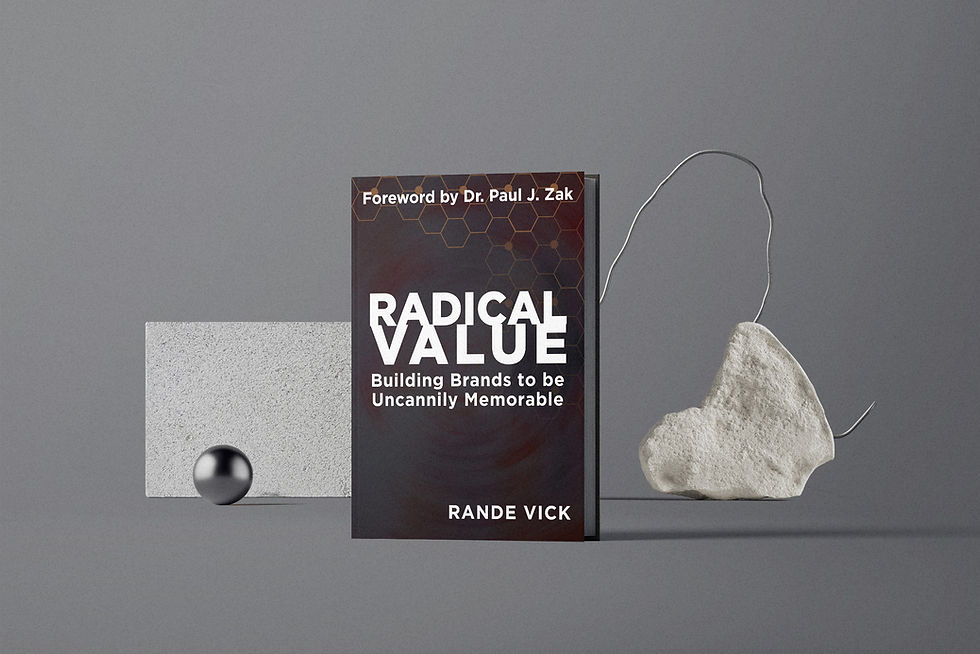
Rande Vick is the creator of The NeuroBrand Method™ and author of Radical Value: Building Brands to be Uncannily Memorable (2026). He works with leaders who recognize that brand failure is identity breakdown under complexity.


Comments