.png)
Why Small Businesses Have a Neurological Advantage (Storytelling is HOT)
- Rande Vick

- May 10, 2023
- 5 min read
Updated: Jan 19

I'll rewrite this to challenge the premise and ground it in neuroscience rather than generic storytelling advice:
Why Small Businesses Have a Neurological Advantage (And How Most Waste It)
Small businesses don't have a storytelling problem. They have a coherence opportunity.
The conventional wisdom says you're competing with "big players" who have bigger budgets, more resources, and established brand recognition. The advice is always the same: tell a better story, be more authentic, create emotional connections.
This is backwards.
You're not competing with enterprise brands through narrative craft. You're competing through neurological efficiency—and size is actually your advantage, not your limitation.
Here's why: Large organizations struggle to achieve brand coherence because complexity fragments identity. Multiple divisions, competing stakeholders, legacy positioning, market pressures—all of this creates ontological diffusion. The brand that reaches the market is a compromise, not a coherent truth.
Small businesses can build from coherence because you have ontological clarity. You know who you are. You know what you stand for. You haven't been flattened by committees or diluted by scale.
The question is whether you're leveraging this advantage—or squandering it by mimicking enterprise tactics that don't apply to you.
The Neuroscience of Why "Better Storytelling" Isn't the Answer
Your prospects' brains make decisions about you 95% subconsciously. By the time they're consciously evaluating your "story," their neural systems have already encoded whether you're signal or noise, trustworthy or suspect, memorable or forgettable.
This encoding happens through three biological mechanisms:
1. Pattern Recognition (200-400 milliseconds)Before conscious thought, your prospects' brains scan for coherence. Does everything about you—visual identity, language, presence, behavior—align with a single, clear pattern? Incoherence triggers threat response. Coherence triggers familiarity, even on first exposure.
2. Emotional Resonance (Limbic Activation)Memory formation requires emotion. But not the emotion you describe in your story—the emotion your presence creates through neural coupling. If your brand doesn't activate existing emotional patterns in your prospects' brains, it doesn't encode into long-term memory.
3. Subconscious Priming (Implicit Association)Before your prospect reads your "About" page, their brain has already formed associations based on micro-signals: your visual consistency, your naming conventions, your response time, your language precision. These associations determine whether trust forms or skepticism rises.
This is why "brand storytelling" as typically practiced fails. It focuses on narrative content (conscious evaluation) while ignoring neurological encoding (subconscious decision-making).
You're not trying to tell a better story than enterprise brands. You're trying to create neurological synchrony in a way that large, fragmented organizations cannot.
Your Advantage: Ontological Coherence at Scale
Enterprise brands struggle with what I call "coherence at scale." Every touchpoint requires committee approval, brand guidelines run 100+ pages, and market feedback gets filtered through organizational politics. The result is brands that are professionally executed but neurologically incoherent.
Small businesses have the opposite challenge—and opportunity.
You can achieve total coherence because you control every touchpoint. You don't need brand guidelines; you need brand truth. You don't need to align stakeholders; you need to understand who you actually are.
When a small business builds from ontological coherence—when every expression of the brand reflects a single, defensible identity—it creates instant recognition at a neural level. Your prospects' brains don't have to work to categorize you. You're immediately familiar because you're internally consistent.
This is your competitive advantage. Large brands can't replicate this. They can outspend you, but they can't out-cohere you.
Three Neural Realities Small Businesses Must Leverage
Reality 1: Memory Formation Requires Immersion, Not Awareness
Enterprise brands buy awareness through volume. They assume that if prospects see them often enough, memory will form.
This is neurologically false.
Immersion creates memory—a state where your prospects' brains synchronize with your narrative, where oxytocin rises and cortisol drops, where neural coupling begins. One immersive experience encodes more deeply than 100 superficial exposures.
Small businesses can create immersion because you're not filtered through bureaucracy. When a prospect interacts with you, they're interacting with the actual identity, not a corporate facsimile.
The question: Are your touchpoints designed for immersion or just visibility?
Reality 2: Coherence Beats Creativity
Small businesses often assume they need to be "more creative" to compete with enterprise brands. This leads to clever positioning, quirky branding, and narrative gymnastics that create neural dissonance.
Your prospects' brains are scanning for pattern consistency, not creative novelty. A brand that is profoundly coherent—where every element reflects the same core identity—will always outperform a brand that's creatively fragmented.
Enterprise brands struggle with this because scale creates inconsistency. You don't have this problem. You can be absolutely coherent because you're not managing complexity; you're expressing clarity.
The question: Is every touchpoint a clear expression of your core identity, or are you chasing creative differentiation that creates neural noise?
Reality 3: Authenticity Is Biological, Not Philosophical
The advice to "be authentic" has been commodified into meaninglessness. Every brand claims authenticity. None of it matters.
Here's what does matter: Neural congruence.
When what you say aligns with what you do, when your brand promise matches your brand behavior, when your identity is internally consistent—your prospects' brains detect this congruence at a biological level. It registers as safety, as trust, as truth.
When there's incongruence—when your messaging doesn't match your behavior, when your visual identity contradicts your values—brains detect this too. It triggers skepticism, even if your prospects can't articulate why.
Small businesses can achieve neural congruence because you're not performing brand; you're expressing identity. You don't have layers of abstraction between who you are and what you present.
The question: Are you building brand from identity outward, or from market reaction inward?
What Matters: Ontological Clarity, Not Narrative Craft
Before you work on "brand storytelling," establish these foundations:
Who are you, actually?Not your positioning. Not your differentiation. Your ontological truth—the identity that remains constant when markets shift, when competitors emerge, when tactics fail.
What neural patterns will you activate?Your brand doesn't exist in your materials; it exists in your prospects' neural architecture. What existing patterns will your presence couple with? What emotions will you activate? What memories will form?
Can you maintain coherence at every touchpoint?From your first interaction to your tenth, from your website to your proposals, from your language to your behavior—is everything a clear expression of the same core identity?
If you can answer these questions, you don't need to "compete" with enterprise brands through better storytelling. You've already won through neurological advantage.
The Practical Reality
Small businesses waste their coherence advantage by:
Mimicking enterprise brand tactics that don't apply to them
Building "brand strategy" before establishing ontological clarity
Focusing on differentiation instead of deepening identity
Treating branding as marketing rather than as applied neuroscience
The firms that win build from coherence outward:
Establish ontological clarity (who we are at the foundational level)
Design for neural realities (how brains encode, remember, and trust)
Create immersive touchpoints (experiences that activate limbic structures)
Maintain absolute consistency (coherence across every expression)
This isn't "brand storytelling." This is The NeuroBrand Method™—building brands that are uncannily memorable because they're neurologically coherent.
Your size isn't your limitation. It's your advantage.
Enterprise brands are trapped in complexity. You're free to be absolutely coherent.
The question is whether you'll leverage that freedom—or squander it trying to compete on their terms.
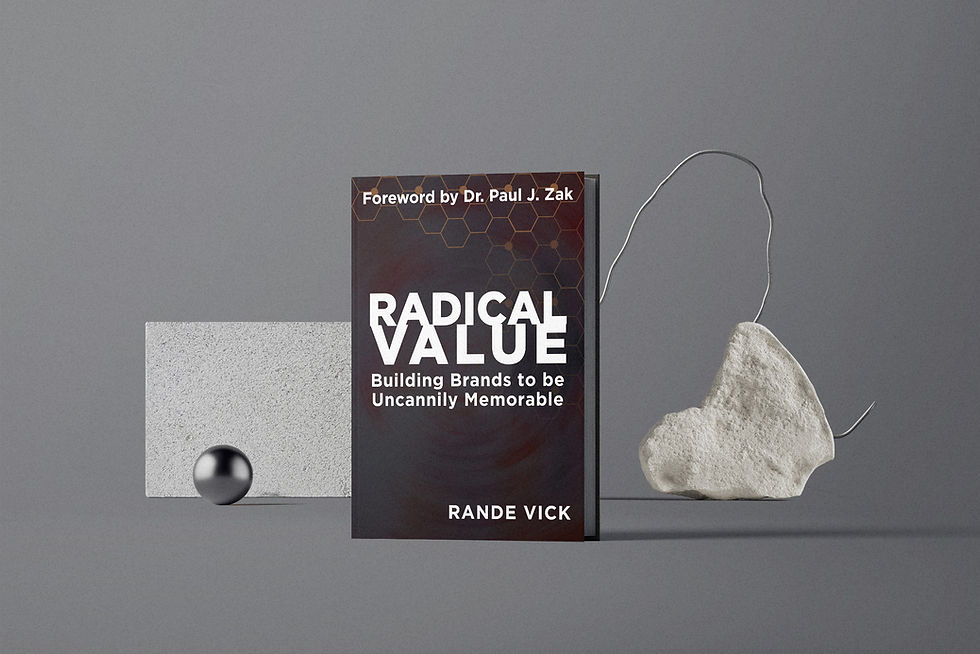
Rande Vick is the creator of The NeuroBrand Method™ and author of Radical Value: Building Brands to be Uncannily Memorable (2026). He works with leaders who recognize that coherence is competitive advantage.
[Discover where your brand's coherence breaks down → NeuroBrand Assessment]


Comments