_edited_.png)
Elevate Your Brand Strategy
- Rande Vick

- Apr 22, 2024
- 3 min read
Updated: Jan 19
A Brand Strategy Guide For Professional Services in LA

Your brand is not your logo. More importantly, your brand is not a marketing problem.
In professional services, what you call "brand issues" are actually identity breakdowns under complexity. When your firm feels forgettable, when positioning feels forced, when messaging doesn't land—you're not experiencing a creative failure. You're experiencing a coherence crisis.
Here's what neuroscience reveals: 95% of your clients' decisions about you happen subconsciously, processed through neural patterns formed before conscious evaluation ever begins. Your brand isn't what goes through their minds when they think about you—it's what their brains encode about you without thinking at all.
This is why traditional brand strategy fails. It treats symptoms (inconsistent visuals, unclear messaging) rather than cause (incoherent identity under market complexity).
The NeuroBrand Method™: Building Coherence as Competitive Advantage
Great brands aren't built through better tactics. They're built by establishing three neurological realities:
1. ImmersionYour brand must create neurological synchrony—a state where your clients' brains literally align with your narrative. This isn't metaphor; it's measurable biology. When prospects experience true immersion with your brand, oxytocin levels rise, cortisol drops, and neural coupling begins.
2. Neural CouplingYour story must couple with existing neural patterns in your clients' brains. This means your brand isn't created by you—it's co-created in the neural architecture of those who experience it. The question isn't "What's our message?" It's "What neural patterns will our presence activate?"
3. Subconscious PrimingBefore your prospect consciously evaluates your credentials, their brain has already decided. Subconscious priming determines whether you're processed as signal or noise, whether you're encoded as familiar or foreign, whether trust forms or suspicion rises.
These aren't brand "pillars." They're biological requirements for memorability.
Why Most Professional Services Brands Fail
You're solving for the wrong problem. You think you need:
A "unique brand voice"
Better visual identity
Clearer positioning
More compelling storytelling
But what you actually need is ontological coherence—a brand identity so internally consistent that it creates instant recognition at a neural level.
When law firms, consultancies, and professional services struggle with brand, it's not because their logo is wrong or their messaging needs tweaking. It's because they've built their identity on market reactions rather than core coherence. They're trying to "position" their way into relevance instead of building from a foundation of neurological truth.
The Ontological Question: Who Are You Actually?
Before tactics, ask the deeper question: What is your firm's actual identity?
Not your positioning. Not your differentiators. Your ontological reality—who you are when no one's watching, when the pitch deck closes, when the market shifts.
Most firms skip this entirely. They jump straight to "How do we stand out?" without first establishing "What do we stand for?"
This creates the flattening you're experiencing—where every firm sounds like every other firm, where "thought leadership" feels forced, where marketing becomes increasingly expensive and decreasingly effective.
Four Neural Realities for Building an Unforgettable Brand
Reality 1: Your clients' brains decide about you in 400 millisecondsEverything—your website, your first meeting, your proposal—is either neurologically congruent with who you say you are, or it's creating dissonance. There is no middle ground at the subconscious level.
Reality 2: Coherence beats creativityA brand built on deep internal coherence will always outperform one built on clever positioning. Your prospects' brains are scanning for consistency across every touchpoint. Incoherence triggers threat response; coherence triggers trust.
Reality 3: Memory formation requires emotional resonanceYour clients won't remember your credentials. They'll remember how your presence made them feel—and that feeling is determined by neural coupling, not by what you said in the pitch.
Reality 4: Your brand exists in their biology, not your materialsYou can control your inputs (messaging, visuals, experience). You cannot control the neural encoding that happens in your clients' brains. But you can design for the biological realities of how memory, trust, and decision-making actually work.
The Deeper Work
Building a brand in professional services isn't about better marketing. It's about:
Establishing ontological coherence—who you are at the foundational level
Designing for neural realities—how brains actually encode and recall brands
Creating immersive experiences—where clients neurologically synchronize with your narrative
Building from identity outward—not from market reaction inward
In today's flattened professional services landscape, tactical differentiation is temporary. Neurological coherence is permanent.
The question isn't "How do we stand out?"
The question is "Who are we, really—and does every touchpoint reflect that with biological precision?"
That's The NeuroBrand Method™.
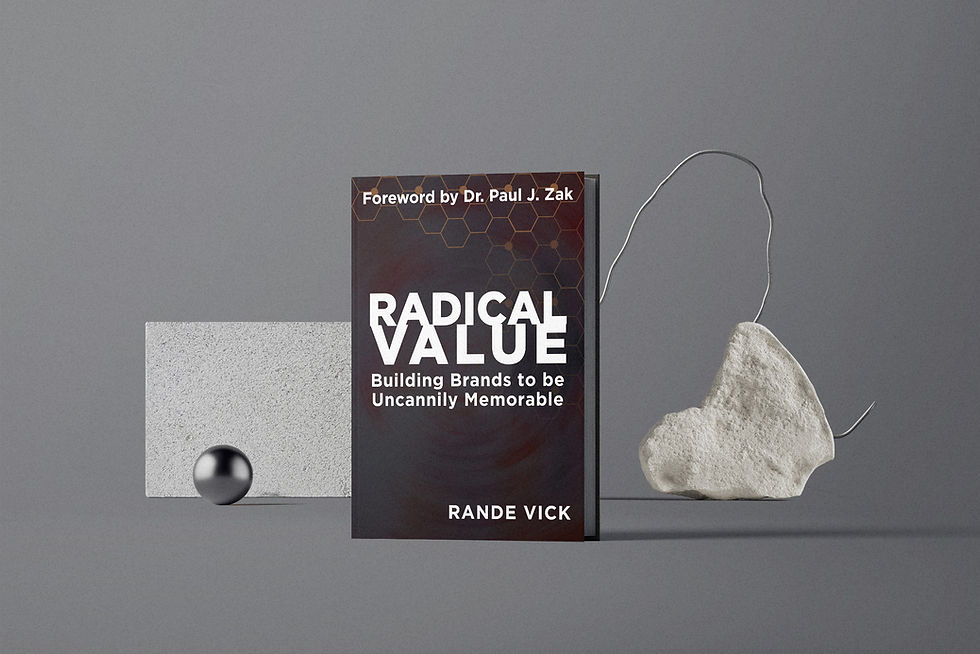
Rande Vick is the creator of The NeuroBrand Method™ and author of "Radical Value: Building Brands to be Uncannily Memorable" (2026). His work applies neuroscience research to brand strategy for leaders who recognize that brand failure is identity breakdown under complexity.
Want to understand where your brand's coherence breaks down? Get in touch today!


Comments