_edited_.png)
Your Competitive Edge: Why Service Businesses Don't Have a Differentiation Problem
- Rande Vick

- May 30, 2024
- 4 min read
Updated: Jan 19

In saturated markets, the advice is always the same: Find your unique selling proposition. Optimize your online presence. Showcase testimonials. Network more. Innovate faster.
Here's the problem: Every firm is doing this. And the more everyone differentiates, the more everyone looks the same.
You don't have a differentiation problem. You have a coherence problem.
Your prospects' brains make decisions about you in the first 400 milliseconds of exposure—before they consciously evaluate your USP, read your testimonials, or compare your services. In that fraction of a second, their neural systems scan for one thing: internal consistency.
Does everything about you align with a single, clear identity? Or does your brand feel like a collection of tactics trying to stand out?
The firms that win aren't the ones with the cleverest positioning. They're the ones with the deepest coherence.
Why Tactical Differentiation Fails
Most service businesses approach competitive edge like this:
Short-term tactics:
Identify unique selling propositions
Optimize website for SEO
Collect testimonials and case studies
Run limited-time promotions
Network actively
Long-term strategies:
Build strong brand identity
Invest in client relationships
Adopt agile planning
Emphasize innovation
Define brand purpose
This isn't wrong. These tactics can generate results.
But they don't create lasting competitive advantage because they're built on differentiation rather than coherence.
Here's the distinction:
Differentiation asks: What makes us different from competitors?Coherence asks: Who are we, actually—and does everything reflect that?
Differentiation is reactive. Coherence is foundational.
When you build from differentiation, you're constantly adjusting tactics to stay distinct as the market shifts. When you build from coherence, your identity remains stable even as tactics evolve.
What Your Brain Actually Responds To
Research from neuroscientist Antonio Damasio shows that decision-making happens primarily through pattern recognition, not rational analysis. Your prospects' brains scan for coherent patterns that signal: This is trustworthy. This is familiar. This makes sense.
Coherent brands process efficiently:
Recognition happens instantly
Cognitive load is low
Trust forms pre-consciously
Memory encoding is strong
Incoherent brands create friction:
Processing requires mental work
Mixed signals trigger skepticism
Memory formation is weak
Decision-making delays
You can have the best USP, strongest testimonials, and most innovative services—but if your brand lacks internal coherence, your prospects' brains will hesitate.
That hesitation is expensive.
The Coherence Audit: Where Service Businesses Break Down
Most service firms fragment their identity across competing demands:
Market pressure: "We need to position against Competitor X"Client feedback: "They want us to emphasize Y"Team input: "Our strength is actually Z"Trend chasing: "Everyone's talking about A, we should too"
Each of these might be valid in isolation. Together, they create incoherence.
Your website says one thing. Your proposals emphasize another. Your team describes you differently than your marketing materials. Your visual identity doesn't match your verbal tone.
The result: Prospects can't quickly categorize who you are. Their brains work harder. Skepticism rises. Memory formation weakens.
Ask yourself:
Identity clarity: Can you describe your firm's core identity in one sentence that everyone on your team would say the same way?
Touchpoint consistency: Do your website, proposals, emails, conversations, and visual presence all reinforce the same identity?
Decision speed: How quickly do prospects move from initial contact to engagement? Long delays often signal coherence issues.
Referral language: When clients refer you, do they describe you consistently—or do different clients emphasize completely different aspects?
If these answers reveal fragmentation, you don't need more tactics. You need foundational coherence.
Building Competitive Edge from Coherence
Start with identity, not tactics:
Before optimizing SEO or crafting USPs, establish clarity:
Who are we when no one's watching?
What remains true regardless of market trends?
Which aspects of our identity are non-negotiable?
This isn't your mission statement. It's your operational truth.
Design every touchpoint from that truth:
Once you have clarity, every tactic becomes an expression of identity:
Your USP isn't what differentiates you from competitors—it's what naturally emerges from who you are
Your brand identity isn't creative exploration—it's visual translation of core truth
Your client relationships aren't just good service—they're behavioral proof of identity
Your innovation isn't chasing trends—it's deepening what you already do distinctively
Test for coherence, not creativity:
Stop asking: "Is this differentiated enough?"Start asking: "Does this reflect who we actually are?"
Stop measuring: clicks, engagement, vanity metricsStart measuring: recognition speed, referral consistency, decision velocity
Practical Application
For immediate impact:
Choose ONE aspect of your identity that's absolutely true and non-negotiable. Make sure every touchpoint this month reinforces that single truth. Not "our three core values" or "our unique approach"—one truth, repeated coherently.
For sustainable growth:
Audit where your identity fragments:
Where does your team describe you differently?
Where do your materials contradict each other?
Where are you trying to be something you're not?
Eliminate the fragmentation. Deepen what's true.
For competitive advantage:
Stop competing on differentiation (what makes you different) and start competing on coherence (how clearly you express who you are). The market is oversaturated with "unique" firms. It's undersupplied with coherent ones.
Why This Creates Lasting Edge
Tactical differentiation is temporary. Someone can always copy your USP, match your innovation, or outspend your marketing.
But no one can replicate your coherent identity. Because coherence isn't a position you claim—it's truth you embody.
When prospects encounter a firm built from deep coherence:
Recognition is instant
Trust forms pre-consciously
Memory encodes efficiently
Referrals describe you consistently
This isn't competitive edge you build through better tactics. It's competitive edge that emerges naturally when everything you do reflects who you actually are.
"He who has a 'why' to live for can bear with almost any 'how.'" — Friedrich Nietzsche
Your competitive edge isn't found in the 'how' of tactics. It's found in the 'who' of identity.
The firms that stand out aren't the ones differentiating hardest. They're the ones expressing most coherently.
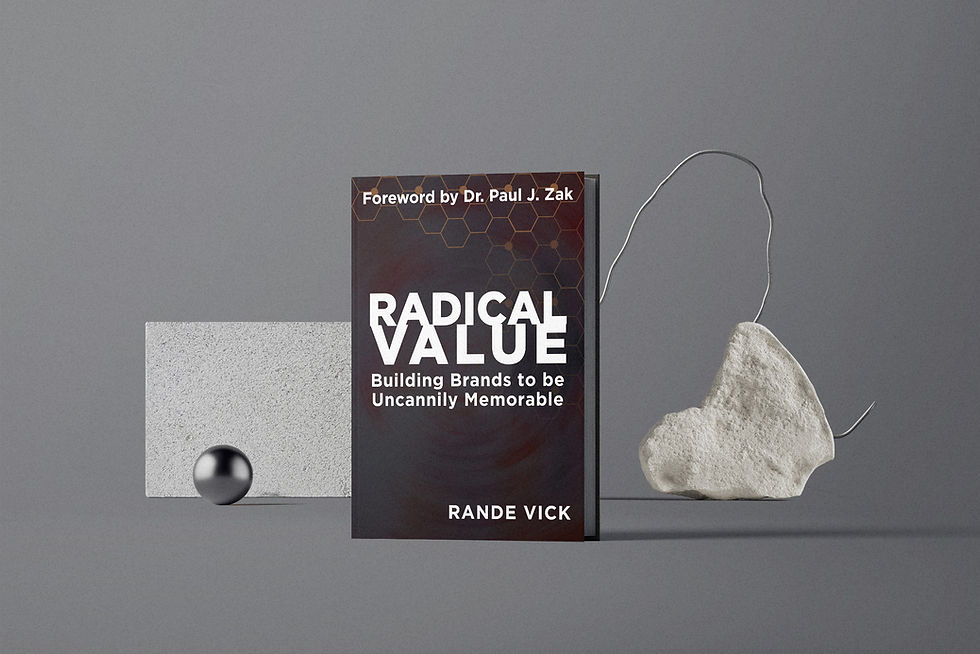
Rande Vick is the creator of The NeuroBrand Method™ and author of Radical Value: Building Brands to be Uncannily Memorable
Ready to get started? Contact the Vick Agency today!


Comments